
This edition of Write On first went out to the newsletter on LinkedIn on 30 October 2026. Read the original and the comments on LinkedIn.
Happy Halloween.
This year I've been building the systems behind my businesses: the CRM, the content pipeline, the AI agents that draft while I sleep and wait for my approval before anything goes out. I expected the hard part to be the technology. It wasn't.
The hard part was the haunting. A lead that "definitely got a follow-up" that nobody sent. A decision we'd already made, back from the dead in another meeting. A spreadsheet that said one thing while the CRM said another, and both were moving on their own.
None of those were tool problems. Every one of them was a communication problem dressed up in a costume.
There's a name for this. In 1968, a computer scientist named Melvin Conway observed that organizations design systems that mirror their own communication structures. It's now called Conway's law, and here's what it means in plain English: if your team talks in ghosts, your system will too. You can buy the best software on the market, but it will faithfully reproduce every unclear handoff you already have.
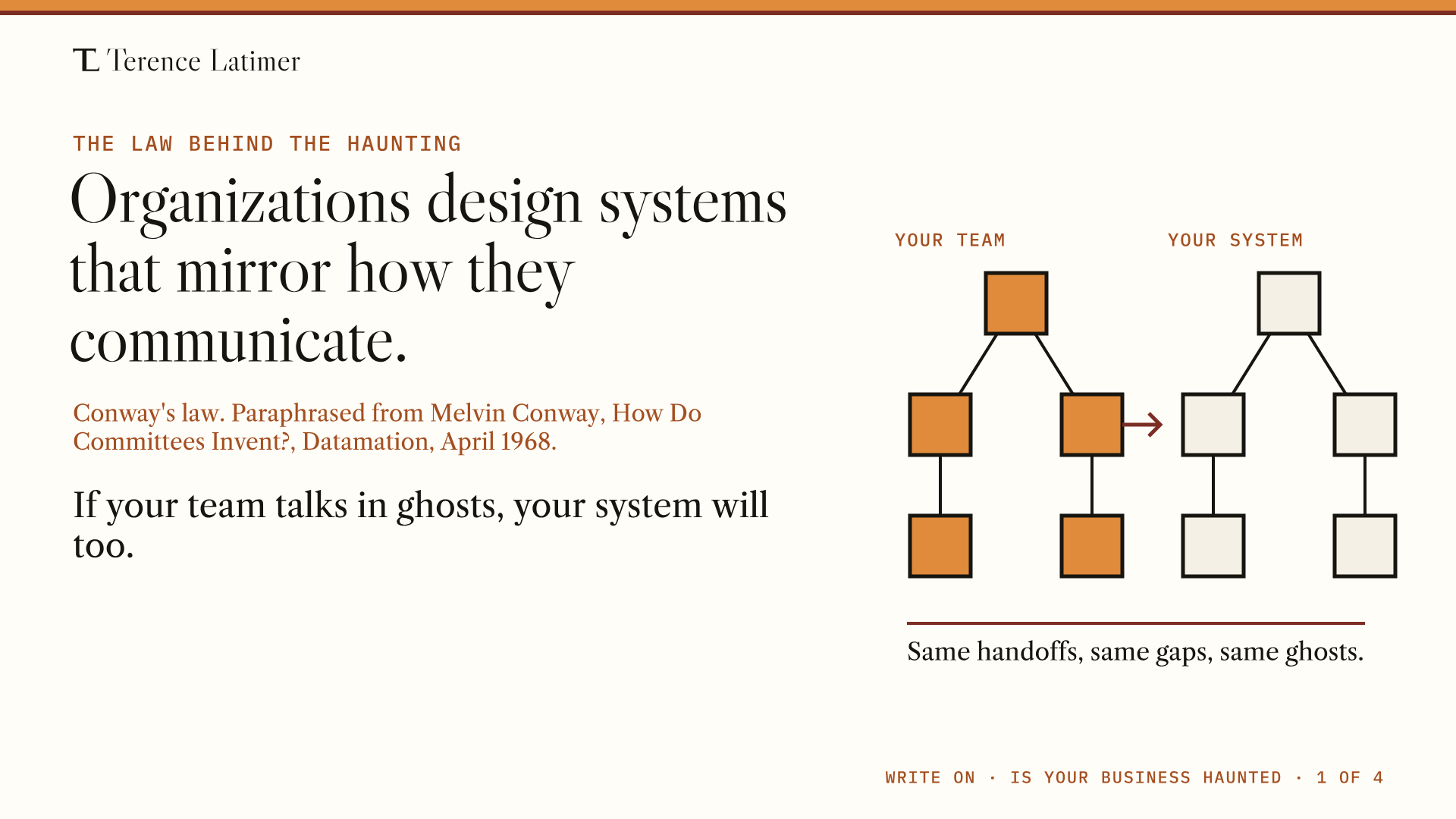
Conway's law in one picture: your system inherits the shape of your conversations.
So this edition is a ghost hunt. Here are six ghosts I keep finding in growing businesses, mine included, and how to clear each one out, inside the house (your team) and outside it (your clients).
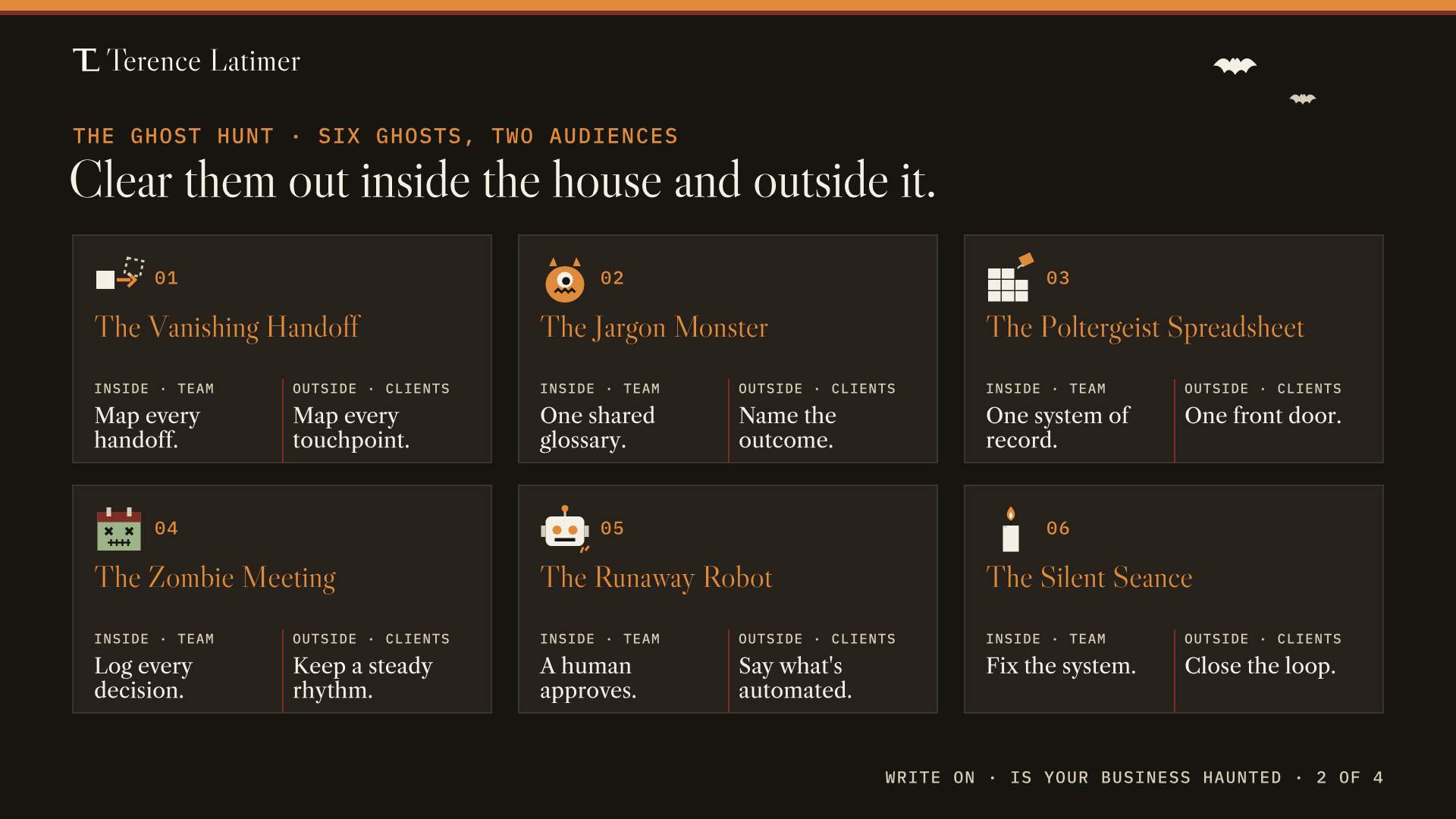
Six ghosts, two audiences. Clear each one inside the house and outside it.
1. The Vanishing Handoff
Work rarely disappears inside a tool. It disappears between people: the moment one person thinks they've passed something on and the other person never caught it.
Inside the house: map who hands what to whom. Draw it on a whiteboard if you have to. Every arrow is a place work can vanish, so name an owner for each one.
Outside the house: map every touchpoint a client sees, from the first post they read to the final invoice. Gaps you can't see inside show up as silence on the outside.
Takeaway: the handoff is the system. Design it on purpose.
2. The Jargon Monster
Ask three people on your team what a "lead" is and you may get three answers. That monster eats reports, forecasts and trust.
Inside the house: keep one shared glossary. Lead, client, project, done: write down what each word means in your business and use it the same way everywhere.
Outside the house: name the outcome, not the plumbing. Clients don't buy your stack. They buy the result, in words they'd use themselves.
Takeaway: shared words are infrastructure. Treat them that way.
3. The Poltergeist Spreadsheet
Five versions of the truth, all moving on their own. Someone updates the spreadsheet, someone else updates the CRM, and the numbers drift apart in the dark.
Inside the house: one system of record. For me that's Odoo, and the rule is simple: if it isn't in the record, it didn't happen.
Outside the house: one front door. Every social post, profile and email should point back to a website and a list you own, not to a rented space that can change its rules overnight.
Takeaway: pick one source of truth, then make every other tool point to it.
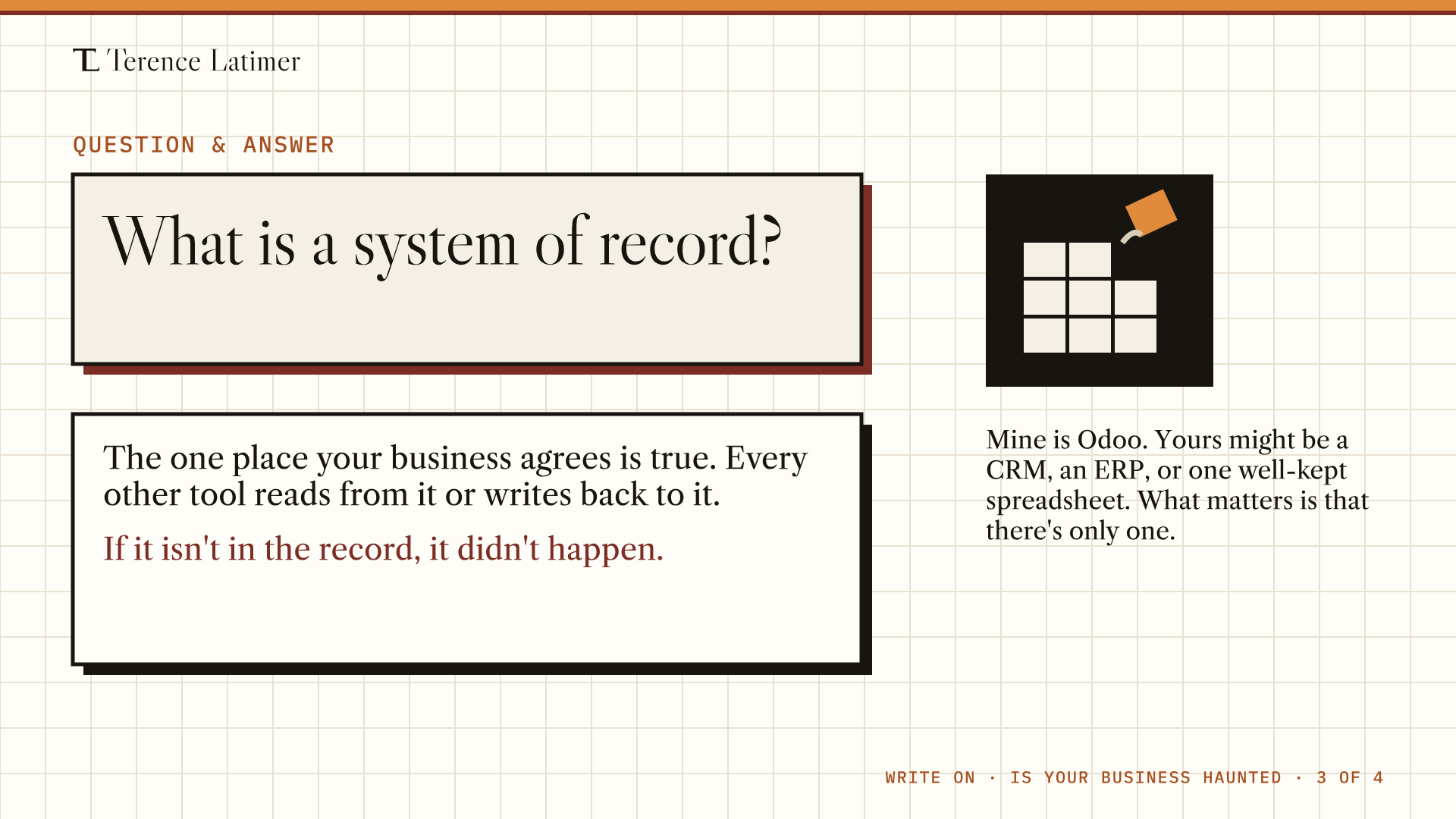
One record, one truth. Every other tool reads from it or writes back to it.
4. The Zombie Meeting
Some decisions won't stay dead. You settle something on Tuesday, and by the next Tuesday it's shambling back into the agenda because nobody wrote down what was decided or why.
Inside the house: a weekly review and a decision log. One line per decision: what, why and who. Settled decisions stay buried.
Outside the house: a steady rhythm. A regular letter, clear status updates, no jump scares. Clients relax when they know when they'll hear from you.
Takeaway: if it isn't written down, it isn't decided.
5. The Runaway Robot
Automation is a gift until it runs without a leash: the email that sends itself to the wrong list, the post that publishes before anyone reads it, the agent that "helpfully" changes a record of truth.
Inside the house: automation drafts, and a human approves anything that sends, spends or publishes. In my own systems, every agent stops at a gate and waits for me.
Outside the house: tell people what's automated and where a person steps in. Trust is a feature, and transparency is how you ship it.
Takeaway: AI is a tool. Keep a hand on it.
6. The Silent Séance
You ask for feedback, collect it, and then nothing happens. People notice, and they stop speaking up.
Inside the house: log what happened, review it and fix the system, not just the people. Most mistakes are design problems wearing a person's face.
Outside the house: ask, listen and reply. Then show clients what changed because they spoke up. That's how a one-time customer becomes a community.
Takeaway: feedback without follow-through is just a séance. Close the loop.
The rule I build by
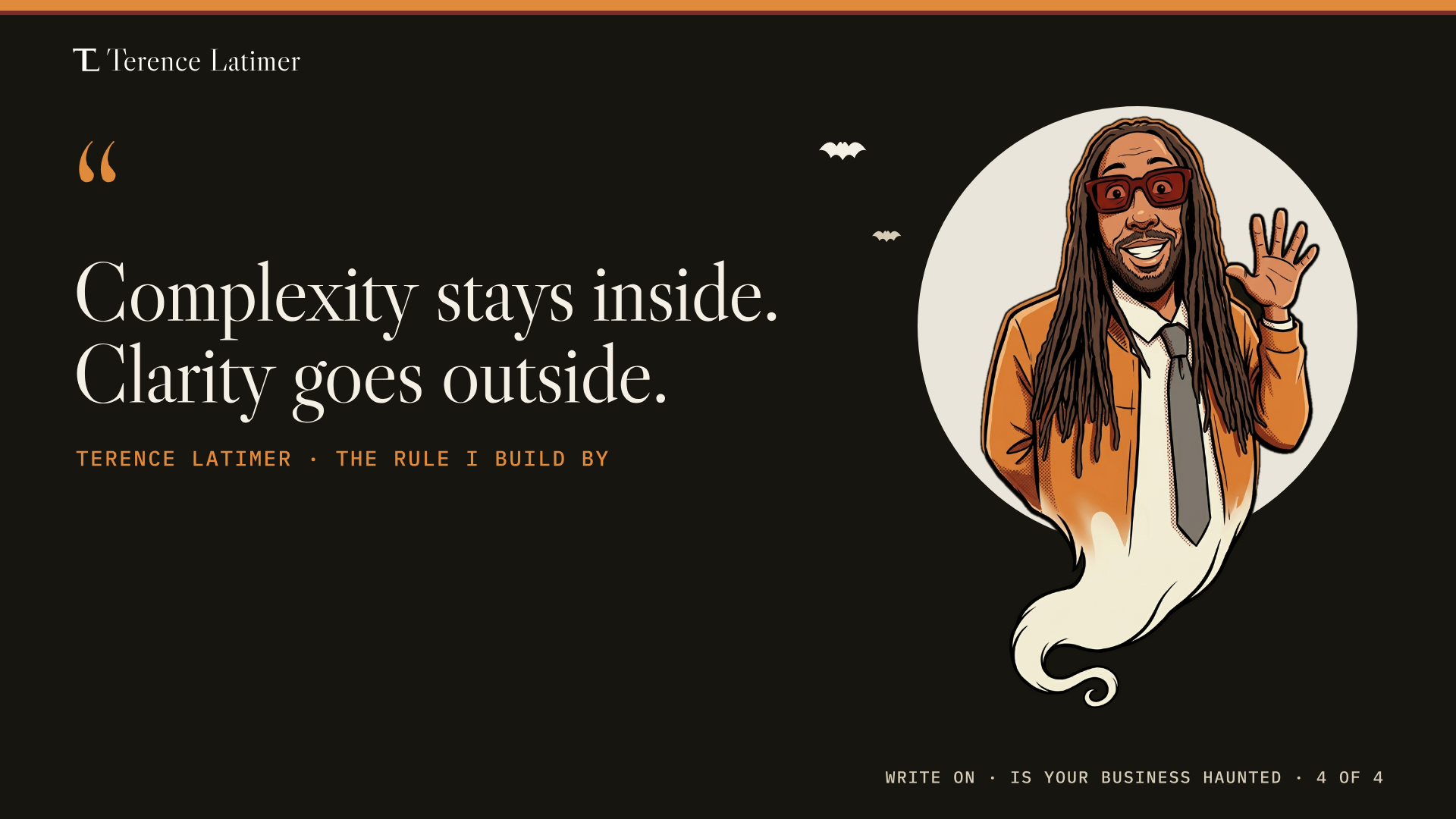
The rule I build by. (Yes, that's me as a ghost. It's Halloween.)
Complexity stays inside. Clarity goes outside.
Your systems can be as sophisticated as they need to be behind the walls. What your team and your clients experience should feel simple, consistent and human. That's the whole job.
Your turn
Which ghost is haunting your business right now? Tell me in the comments on LinkedIn. I'll pick a few and answer them in a future edition.
If you want to know how much of your digital house you actually own, versus rent, the Digital Real Estate Audit is free and takes about two minutes: terencelatimer.com/audit
Write On also goes out by email, with the stories that don't fit here: what I'm building, reading and learning out in 29 Palms. Get it in your inbox →
Write on,
Terence
Source: Melvin E. Conway, "How Do Committees Invent?", Datamation, April 1968.