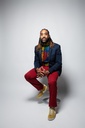
Watch the video essay above, or read the written version below.
The Blueprint on the Big Blue Bus
One of my earliest memories of really being moved by music comes in the form of The Blueprint. I listened to that CD over and over again on a crystal-blue CD player, a JVC or a Panasonic, that got me through high school. I'd play that album front to back riding the Santa Monica Big Blue Bus between the Palisades and the Promenade. We'd go to Tower Records and the record shops to find the CDs we wanted and the artists we loved. Jay-Z was one of my favorites.
SoFi was the third time I've seen him. The first was at the Palladium, still one of my favorite concert experiences ever. The second was at the Rose Bowl, on the Legends of the Summer stadium tour with Justin Timberlake. (In the video I call it the Suit & Tie tour; it was Legends of the Summer, 2013.) The third was closing night at SoFi Stadium on Saturday, October 24, 2026: the JAY-Z 30 tour, marking 30 years of Reasonable Doubt.
The trouble with heroes
Teenage Terence loved Jay-Z for the swag: the aura, the confidence, the wordplay. When you think about how much parroting and mirroring we do when we're young, he was one of my earliest examples of, frankly, a hero. The earliest parts of my career were probably modeled on some of that drip, that luxury, the aura he put into his music and sent to me.
I've started an essay many times and never had the courage to finish it. It's called The Trouble with Heroes. Our heroes, whether musicians, artists, politicians or even family, are human, and they will make mistakes. It's not a matter of if. And we usually see them from a very limited vantage point.
I've had difficulty reconciling some of the ways Jay-Z has been moving recently. I'm frustrated by the perceived treatment of Colin Kaepernick, and I have complex feelings about some of the rumors we hear related to Roc Nation and bullying. But it's easy to cast stones from where I sit. If I walked a mile in his shoes, I know there's a whole universe inside him I'm not privy to. So I'd encourage us all to offer the people we look up to some grace and some accountability, and to update our picture of them as we learn more. Impermanence teaches us that everything changes, including our heroes, and including us.
Jay-Z vs. Sean Carter
I love exploring the overlap between our personal and professional lives: how one drips into the other. A lot of artists pursue the work to express themselves and to change their circumstances. Jay-Z grew up in the Marcy Projects under rough circumstances, and his earliest lessons in professionalism looked more like warfare than a standard career.
His early mentors, the Big Daddy Kanes and Rakims, showed him how to take his internal monologue, his heart and spirit, and put it into the music. And mostly not on paper: Jay-Z freestyles off the dome, which is such a power move. That gave him a way to express the angst and the pain, and the bravado. The character of Jay-Z, as distinct from Sean Carter, was a persona he needed to say things Sean Carter couldn't.
His professional success then changed his personal life: retiring his mother, reconnecting with his father, giving family and community real opportunities, much of which never gets reported.
"I'm not a businessman; I'm a business, man"
He said it himself ("Diamonds from Sierra Leone (Remix)"). There's real complexity in separating who you are as a person from who you are as the business, and for damn sure, his story is a business he is selling. He's selling you. He's selling me. We're buying. So it gets complicated to tell when things are performance and when they're organic, true to who he was and who he's becoming. The story is being told in real time.
The catalog and the creative machine
As a fan, I've lived through the iterations: The Blueprint, The Life and Times of S. Carter, The Dynasty: Roc La Familia, The Blueprint 2.1 (not my favorite), The Black Album and the sadness of watching an icon retire, the Nas beef and the reconciliation, and Beyoncé. Underneath all of it are the sounds of his producers: Just Blaze, Timbaland, Swizz Beatz and, most definitely, Kanye West.
I'm a creative technologist. I love the creativity in technical work and the technicality in creative work. Jay-Z is highly creative, and he has a creative machine around him, rooted in his collaborators: from Dame Dash to Kareem "Biggs" Burke to the team he's built at Roc Nation.
Creativity runs through everything: the album covers, the photography, the videography, the documentaries, the clothes. Together they form a visual identity that lets us, the receivers, build a narrative. An album has a beginning, middle and end. Ideation, production, recording, mixing, distribution, marketing, touring and merch all have their ends too. But this man is still alive, so the story keeps going.
We have to give him his flowers: he is a master of his craft. Part of that mastery is the symphony, quite literally, of leading a team. He knows his role as the artist and the technical creator, and lets the best technicians in the world take a concept from idea into the real world.
The night: SoFi, Saturday, the 200 level
My partner pushed me for weeks to go, and we pulled the trigger at the last minute. I'm grateful she did, because there was real spiritual work for me at that show. We got there a little late. He went on around 9:30, and SoFi, the traffic is not the business. By the time we reached our seats in the 200 level he'd already started, but we had a decent vantage point.
It felt like a safe space for us elder millennials and Gen X. We've seen hip-hop in all its forms, many of us are grumpy about where it's gone, and the crowd was mostly hip-hop heads.
SoFi is gigantic. Its listed capacity is 70,240, and reports put the crowd at about 70,000. (In the video I guessed 15,000. I was way off.) I'm grateful we weren't up in the rafters.
Aura, awkwardness and Andre 3000
Jay-Z gets a lot of points for the cool factor. But at times he seemed a little awkward. My partner says he's a savant; perhaps he's got some neurodivergence, or some awkwardness that comes out when he's not 100% comfortable. LA is a tough crowd; we've seen every version of cool. One of my favorites is Prince, who gave everything he had night after night at the Forum in his 21 Nite Stand in 2011. (In the video I say 30 nights; it was 21.) Jay-Z has some of that enigmatic aura. That night, though, it felt like there were some cobwebs, as if he was working his way back in. As someone who just turned 40, maybe I'm grading him differently.
It reminded me of seeing OutKast at Coachella, and how awkward and shy Andre 3000, the coolest person on the planet, seemed. Our heroes aren't the mythic creatures we think they are. They're men and women. Seeing Jay-Z more human was endearing.
Clothes, screens and symbols
From the 200 level, it looked like he was wearing a bulletproof vest. (That's what I saw; no published report confirms it.) I don't ever remember Jay-Z wearing one; I remember 50 Cent rocking one. My partner remembered a story from the Vol. 2 era, of him coming straight from a photo shoot still wearing one, back when he was moving from the streets into music and was in the middle of a street war. Was the vest a callback to that story, from Volume 1 and Volume 2 to 2026? Or did he feel his life was in danger? I don't know.
There were costume changes. He was mostly in an S. Dot Carter look, including a military-style uniform. Meanwhile the big screens, a single screen spanning the full width of the field, told the visual story and matched it. There were lots of greens and lots of Black people and people of color on screen, shout-outs to the military, what felt like a reclamation of the U.S. flag, and the burial of soldiers. There was also a nod to New Orleans and southern Louisiana, Beyoncé's heritage. My partner felt he was doing some karmic cleaning, and I can take that.
The setlist, the stage, the sound
He took us everywhere: street Jigga, pop Jigga, the dripping-excess Watch the Throne Jigga.
What I loved was that the stage was basically clear. It was him alone, expressing himself. Behind him was a full band, 10 pieces plus an 18-piece string section, all in Yankee hats, playing beautiful music with strings, brass and some electric guitar. Adam Blackstone and Omar Edwards co-directed the music, with Young Guru as his engineer and DJ, and Willo Perron as creative director.
If I'm grading technically, there was reverb distorting the sound at points. SoFi's roof is a fixed translucent canopy, so it's not that "the dome was closed", but the room clearly let the sound bounce around. It's a shame, because this man is a technical rapper, and I wanted to hear the bars.
Setlist: SoFi Stadium, Saturday, October 24, 2026
- The Watcher 2
- Blow the Whistle (Too $hort)
- Izzo (H.O.V.A.)
- Beach Is Better
- FWM
- N—a What, N—a Who (Originator 99)
- Run This Town
- Family Feud
- U Don't Know
- On to the Next One
- Clique
- Dirt Off Your Shoulder
- I Know
- Never Change
- Song Cry
- Dead Presidents
- Where I'm From
- Hard Knock Life (Ghetto Anthem)
- Lucifer
- No Church in the Wild
- D'Evils
- Murder Was the Case (Snoop Dogg)
- The Next Episode (Dr. Dre and Snoop Dogg)
- California Love (Dr. Dre and Snoop Dogg)
- Nothin' but a "G" Thang (Dr. Dre and Snoop Dogg)
- Still D.R.E. (Dr. Dre and Snoop Dogg)
- 99 Problems
- Girls, Girls, Girls
- Excuse Me Miss
- La-La-La (Excuse Me Miss Again)
- Change the Game
- I Just Wanna Love U (Give It 2 Me)
- Money, Cash, Hoes
- Jigga My N—a
- Heart of the City (Ain't No Love)
- Empire State of Mind
- N—s in Paris / Big Pimpin'
- Public Service Announcement (Interlude)
- Encore
Freestyles, Snoop and Dre
He was freestyling right from the start. He freestyled over Snoop Dogg's "Murder Was the Case", and it felt eerie. To my partner's point about clearing karma: are there some bodies on Jigga's name that he just had to release? I don't know. Then he brought out Snoop, who finished the verse. As a West Coast, LA boy through and through, that was deeply spiritual for me. I grew up idolizing Tupac, in the backdrop of West Coast hip-hop, gang culture and the violence of that time. LA has its own legends, and Snoop, another complex figure, is one. When Snoop brought out Dr. Dre for a West Coast run, there was some catharsis for me.
After that, Jay-Z came back for what felt like another 30 to 45 minutes. I rapped his songs with tens of thousands of other fans, and by the end I'd sweated it all out.
The closing speech: seeing isn't believing
He closed with a speech that didn't fully land for me, but I heard it. Perhaps he's neurodivergent and was just trying to flow in the moment. He was encouraging us toward community and connection, and to be perceptive in the age of AI: not all seeing is believing. He asked us to seek out authentic connection, lean into our skills as creators and trust our intuition.
Which raises the question: if seeing isn't believing, why should we listen to you, Jay-Z? Hopefully we take it through the lens of the critical thinking he was encouraging.
Marketing 101: why are we buying?
He's selling us, and we're buying. Marketing 101 says to understand the pain point your customer has before they decide to buy. So, as a fan: what problem am I solving when I buy the CD, the ticket or the merch? Do I feel insecure? Do I want to be close to coolness so I feel cool myself?
That's worth asking about the art, skills and products we sell too. There's creativity in selling. But I don't always want to feel sold to, so put a little sauce on it. And as consumers, let's ask why people are selling us these things and why we're buying.
AI is a tool: tools and rules
On AI, he's not wrong. AI offers us the possibility of a false reality. My encouragement: don't let AI slop replace authentic connection. Use AI. AI is a tool. If we ever work together, you'll hear me say it: be mindful of your toolbox, your tools and your rules.
Just because you have a really dope hammer doesn't mean you know how to build a house.
Using AI doesn't mean you'll build something cool. Become a subject-matter expert. Become excellent at your craft. Then perhaps you'll have the opportunity to make something cool.
I'm Terence Latimer: a creative technologist, writer and entrepreneur based in 29 Palms, and I split my time in Los Angeles. I founded Latimer Digital and own and operate Black Cactus Coworking. Find me at terencelatimer.com/links.