
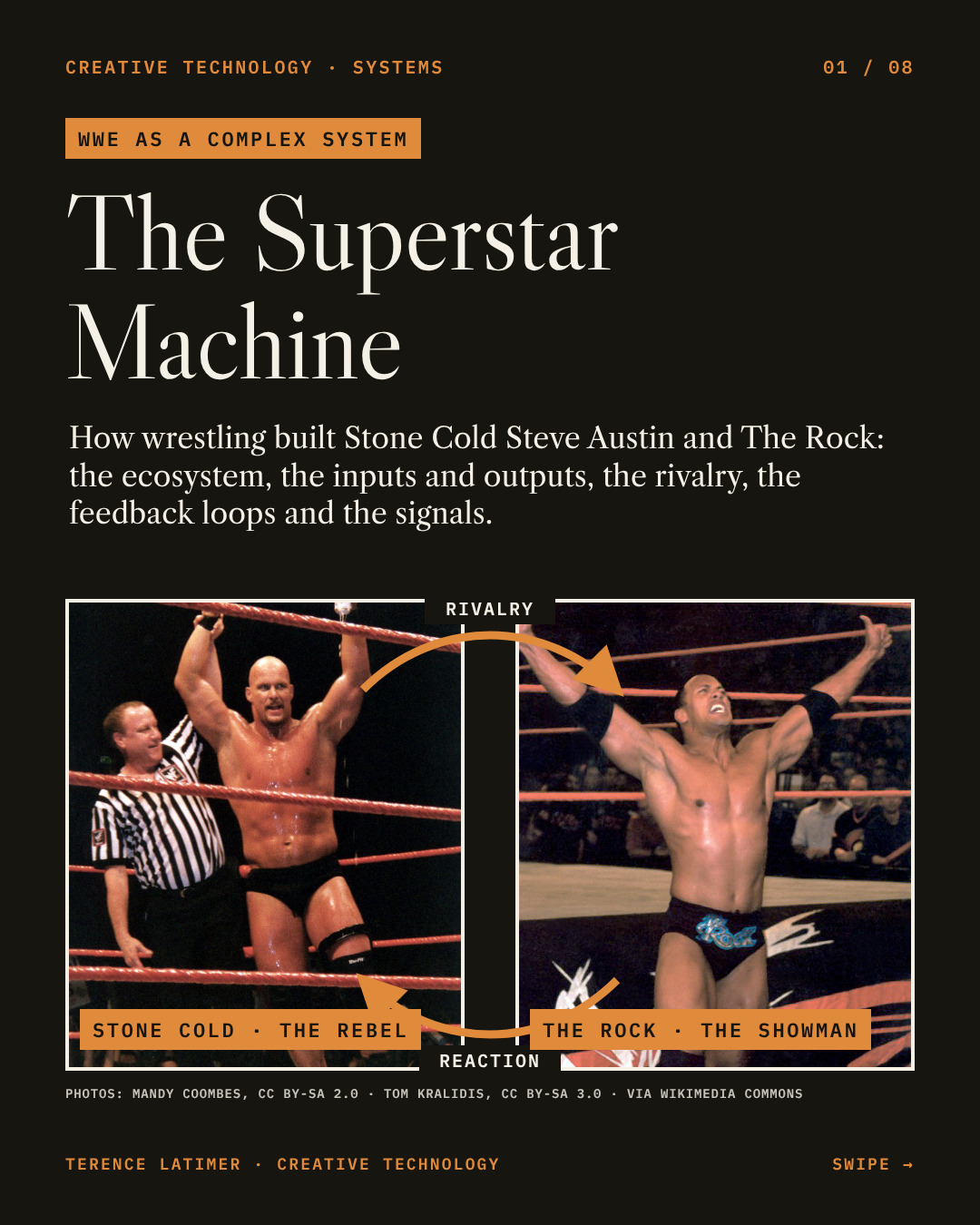
Growing up, I loved The Rock and Stone Cold Steve Austin. We weren't allowed to watch TV during the week, so I only got them on weekends: the highlights, or the weekend show. I missed stories. But I caught up on enough of the feuds to stay hooked.
Looking back now, as someone who builds systems for small businesses, I can see why. Those two weren't just great performers. They were the output of a machine: an ecosystem of writers, crowds, cameras, merchandise and money, tuned every single week, and built so enough of the story reached you, even if you missed Monday night, to keep you coming back.
Here's how that machine worked, and what it can teach you about yours.
In this post:
- The ecosystem: a superstar sits at the center of eight systems
- Inputs and outputs: superstardom has to be fed
- Stone Cold vs. The Rock: the rivalry engine
- Feedback loops: how the crowd made Austin 3:16 and The Rock
- Information: what the machine read in the Monday Night Wars
- Communication: entrances, catchphrases and kayfabe
- Technology: the stage that carries it all
- Bringing it together: one loop
- Your business systems are a superstar machine too
The ecosystem: a superstar sits at the center of eight systems
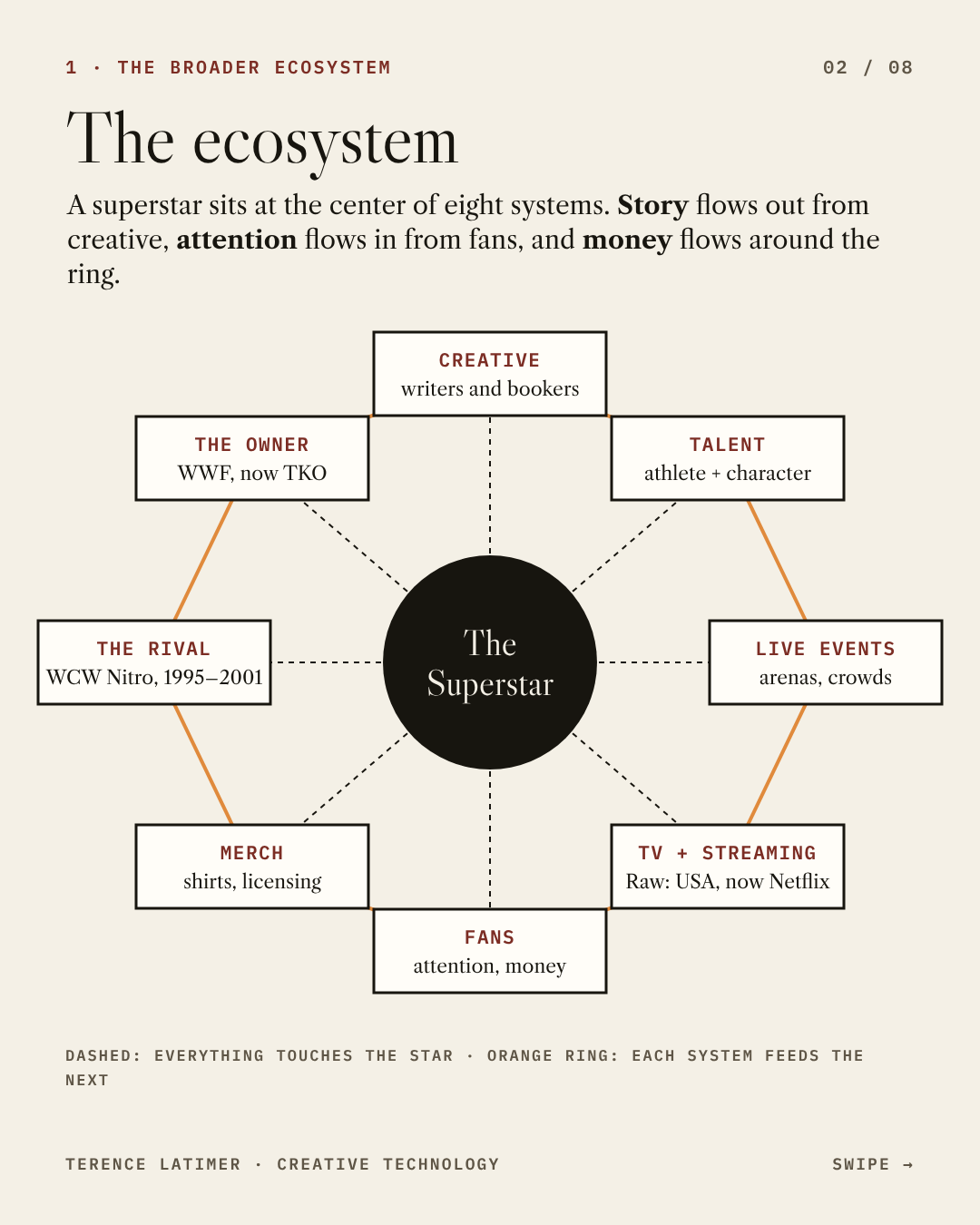
Picture the star in the middle of a ring of systems, each one feeding the next:
- Creative: the writers and bookers who decide the story.
- Talent: the athlete and the character.
- Live events: arenas full of people reacting in real time.
- TV and streaming: Raw on cable for three decades, now on Netflix.
- Fans: the attention, and the money.
- Merch: shirts, licensing, everything with a catchphrase on it.
- The rival: in the late '90s, a whole competing company, WCW.
- The owner: the WWF then, TKO now.
Story flows out from creative. Attention flows in from the fans. Money flows around the ring. Change one system and the others feel it.
Inputs and outputs: superstardom has to be fed
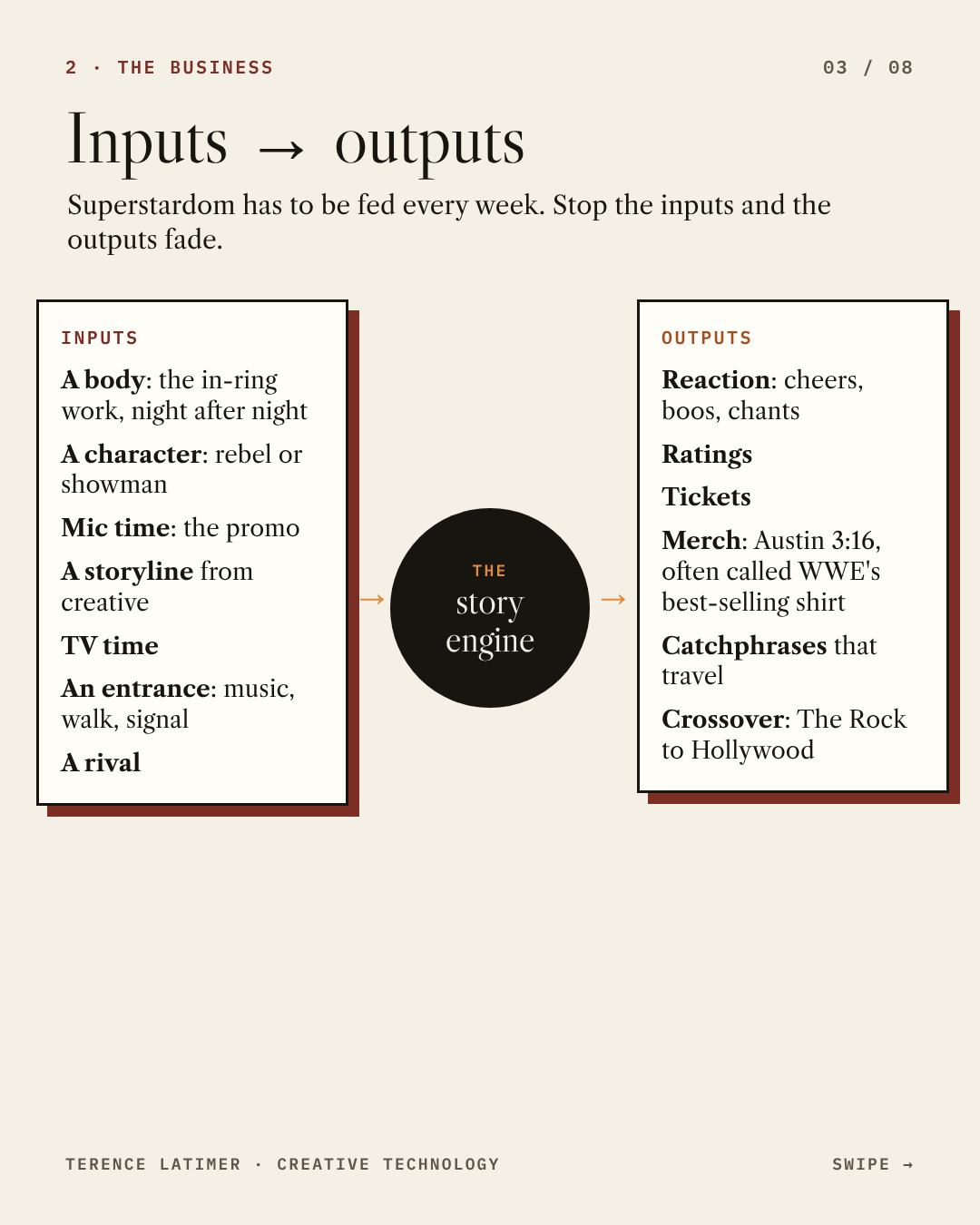
A superstar isn't a thing you have. It's a thing you keep producing. The inputs show up every week: the body that does the work night after night, a character people understand in a second, mic time, a storyline from creative, TV time, an entrance, and a rival.
Run those through the story engine and you get outputs: cheers and boos, ratings, tickets, merchandise (the Austin 3:16 shirt is often called WWE's best-selling shirt ever), catchphrases that travel, and in The Rock's case a whole second career in Hollywood.
Stop the inputs and the outputs fade. That's true in a ring and in a business.
Stone Cold vs. The Rock: the rivalry engine
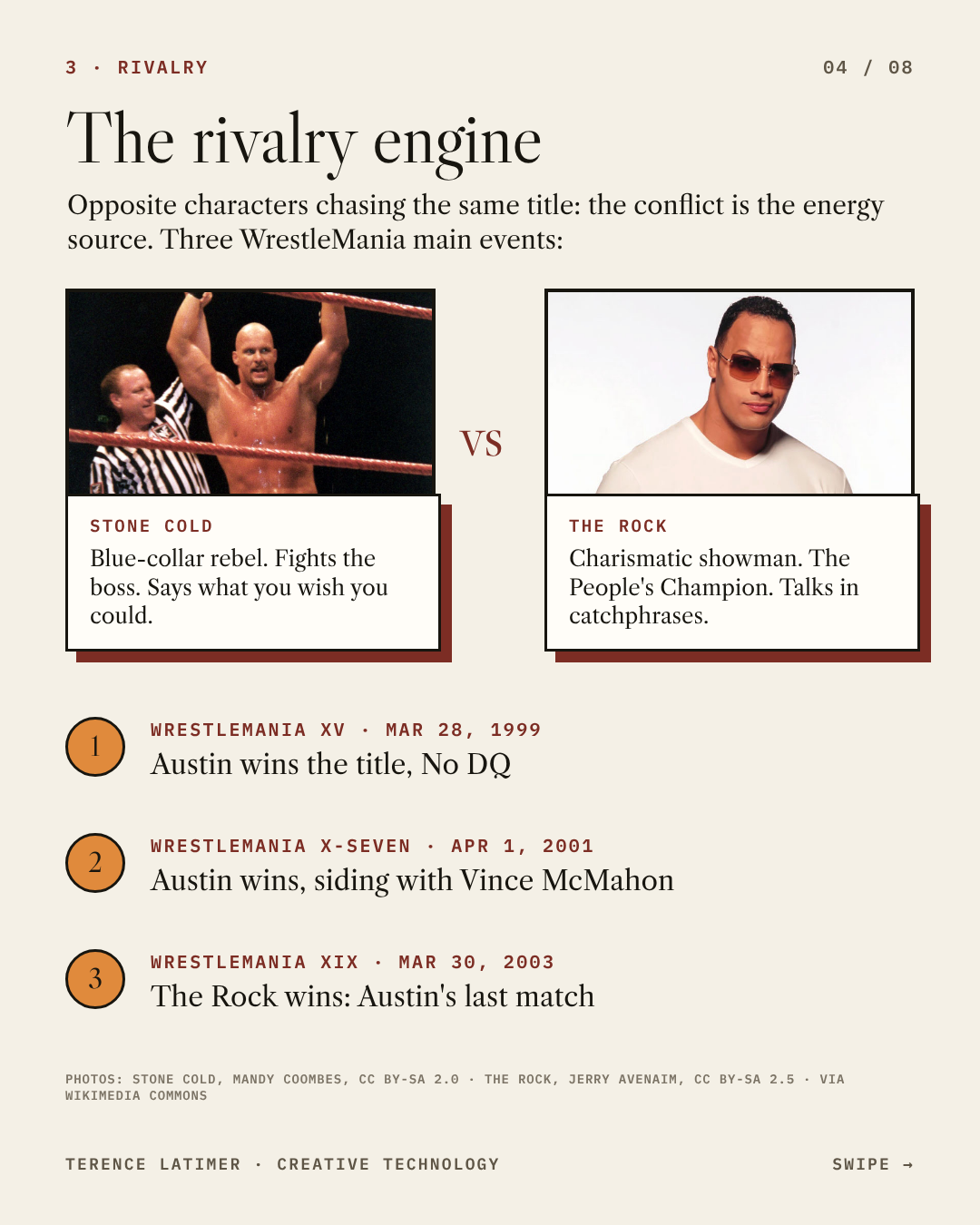
Austin was the blue-collar rebel who fought the boss and said what you wished you could. The Rock was the charismatic showman, the People's Champion, who talked in catchphrases. Opposites, chasing the same title.
They headlined three WrestleManias against each other. Austin won at WrestleMania XV in 1999 and again at X-Seven in 2001, when he shocked everyone by siding with Vince McMahon. The Rock finally won at WrestleMania XIX in 2003, in what became Austin's last match.
A good rival does what a good competitor does in business: it gives your story stakes.
Feedback loops: how the crowd made Austin 3:16 and The Rock
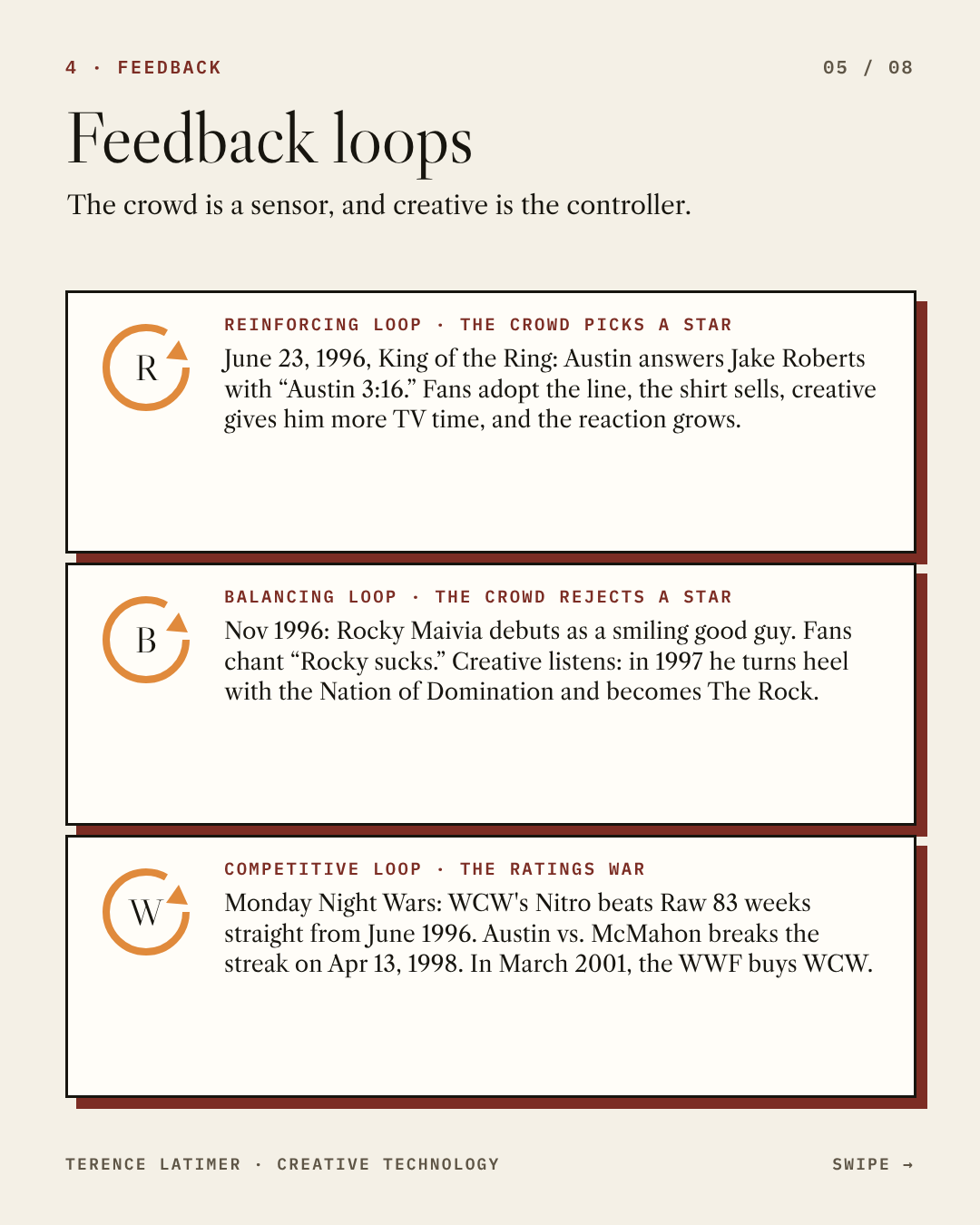
The most underrated part of the machine is how it listened. Three loops did most of the work:
- Reinforcing: at King of the Ring on June 23, 1996, Austin answered Jake Roberts's Bible-quoting promo with “Austin 3:16,” a riff on John 3:16. Fans picked up the line, the shirt sold, creative gave him more TV time, and the reaction grew. Each turn of the loop made the next one bigger.
- Balancing: when Rocky Maivia, the future Rock, debuted in November 1996 as a smiling good guy, crowds chanted “Rocky sucks.” Creative listened. In 1997 he turned heel with the Nation of Domination, and The Rock was born. The rejection was the data.
- Competitive: in the Monday Night Wars, WCW's Nitro beat Raw in the ratings for 83 straight weeks starting in June 1996. A Raw headlined by Austin vs. McMahon broke the streak on April 13, 1998. In March 2001, the WWF bought WCW.
Information: what the machine read in the Monday Night Wars
Every loop runs on information. In the Attitude Era, the machine read four dashboards:
- The live crowd: the fastest signal there is. A pop, a boo or a dead silence tells you in seconds whether a story is working.
- Weekly ratings: the Monday Night Wars had a public scoreboard. Every Tuesday, both companies found out who won.
- Merchandise: fans vote with their wallets. A shirt that sells out is a story that's working.
- Tickets: the slowest signal, and the most honest.
Today the dashboards are faster and finer: streaming numbers, social clips, comments by the minute. But the job hasn't changed. Read the signal, decide, adjust. The company that reads faster, and is willing to change the story when the crowd says so, wins.
Communication: entrances, catchphrases and kayfabe
If information is what comes in, communication is what goes out. Superstardom is a message, and wrestling built brilliant channels for it. (I broke down how a single message travels in Analysis of a Language Event.)
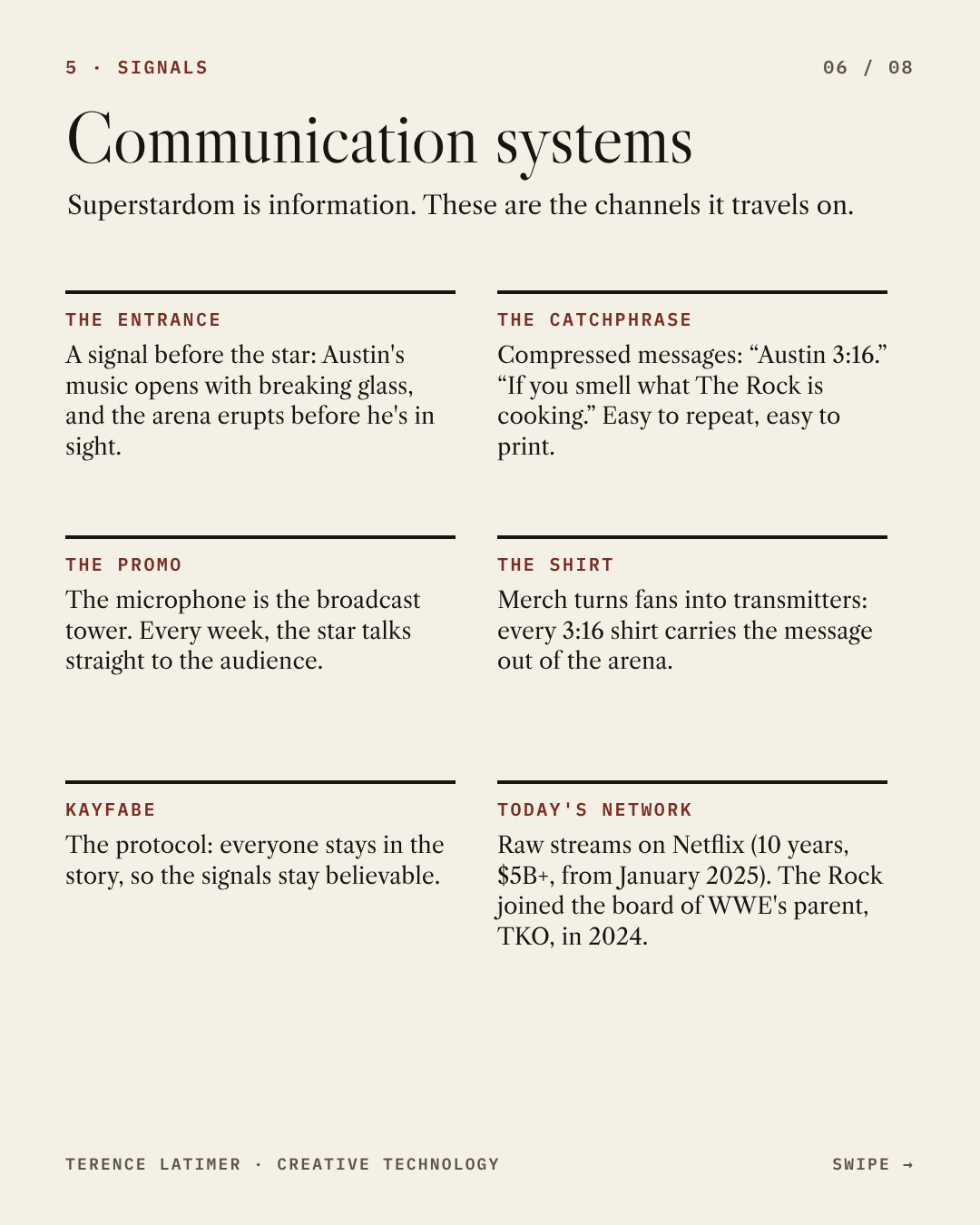
- The entrance: a signal before the star. Austin's music opened with breaking glass, and the arena erupted before he was in sight.
- The catchphrase: a compressed message. “Austin 3:16.” “If you smell what The Rock is cooking.” Easy to repeat, easy to print. That's word design at work.
- The promo: the microphone is the broadcast tower. Every week, the star talks straight to the audience.
- The shirt: merch turns fans into transmitters. Every 3:16 shirt carried the message out of the arena.
- The recap: highlights and the weekend shows carried the week's story to everyone who missed it live. That was me: a kid allowed TV only on weekends. I missed plenty, but the recaps gave me enough of the feuds to stay hooked. A recap doesn't have to carry everything. It has to keep people coming back.
- Kayfabe: the protocol. Kayfabe means treating the scripted story as real, on camera and off. Everyone stays in the story, so the signals stay believable.
Technology: the stage that carries it all
Information comes in, communication goes out, and technology is what carries both. Each time WWE changed its technology, it changed who could see the story and how fast the signal came back:
- Weekly live cable TV: Raw's run on linear TV lasted more than 30 years. Live, every week, is what made the loops so fast.
- Pay-per-view: the big payoffs, sold one event at a time.
- Streaming: the WWE Network launched on February 24, 2014. In 2021, it moved to Peacock in the U.S.
- A global platform: in January 2025, Raw moved to Netflix in a 10-year deal worth more than $5 billion. And The Rock, the rookie fans once chanted out of the building, joined the board of WWE's parent company, TKO, in 2024.
The stage keeps changing. The machine underneath it doesn't. It's the same pattern I wrote about in GTA's 29 years of creative technology and JAY-Z 30 at SoFi Stadium.
Bringing it together: one loop
Put the pieces side by side and it's one system:
- Information comes in: the crowd, the ratings, the merch, the tickets.
- Creative decides: who rises, who turns, who fights whom.
- Communication goes out: entrances, promos, catchphrases, shirts.
- Technology carries it: the arena, cable, pay-per-view, streaming.
- Fans react, and the information comes back in.
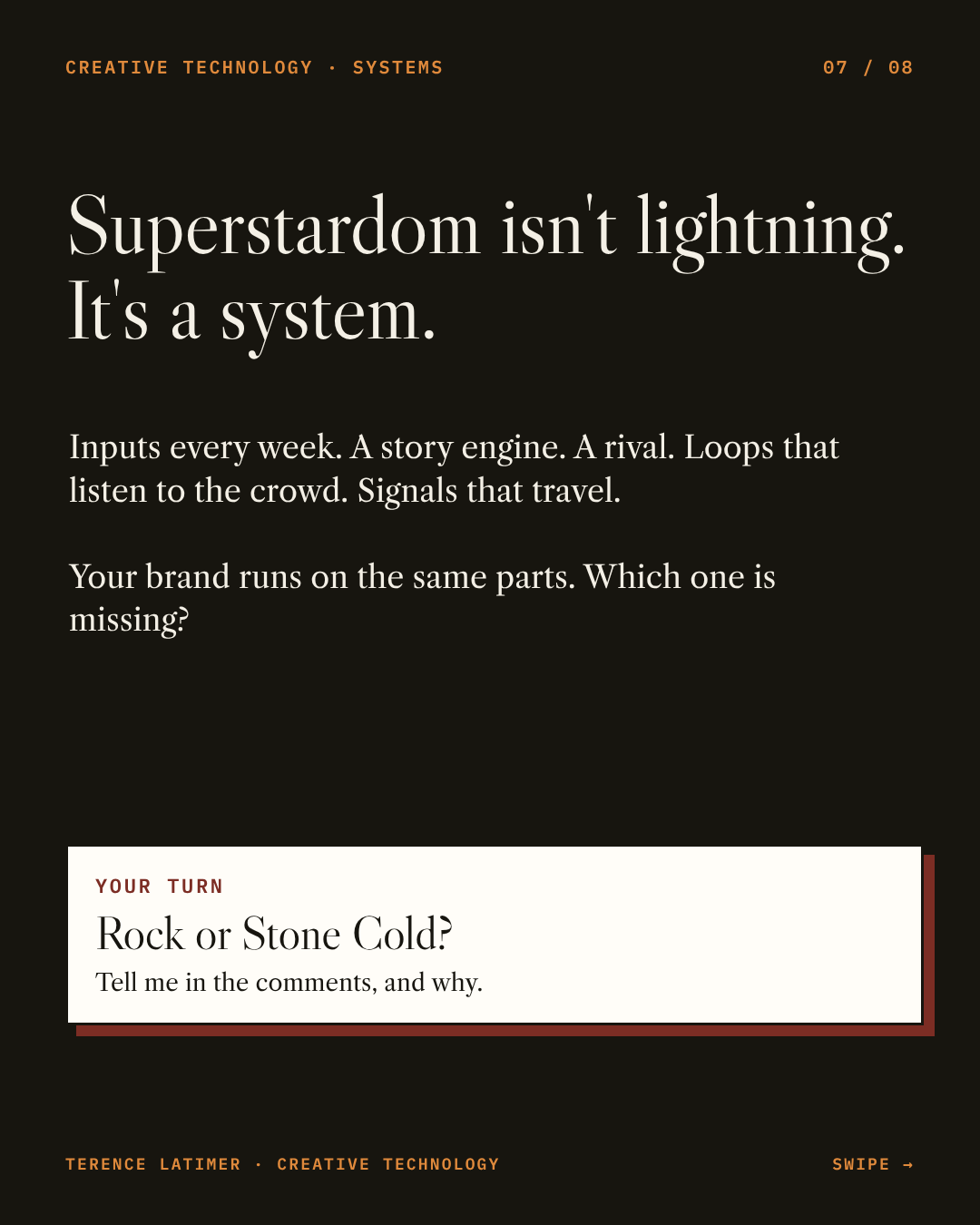
Austin and The Rock weren't lightning in a bottle. They were what happens when every part of that loop is working at once.
Your business systems are a superstar machine too
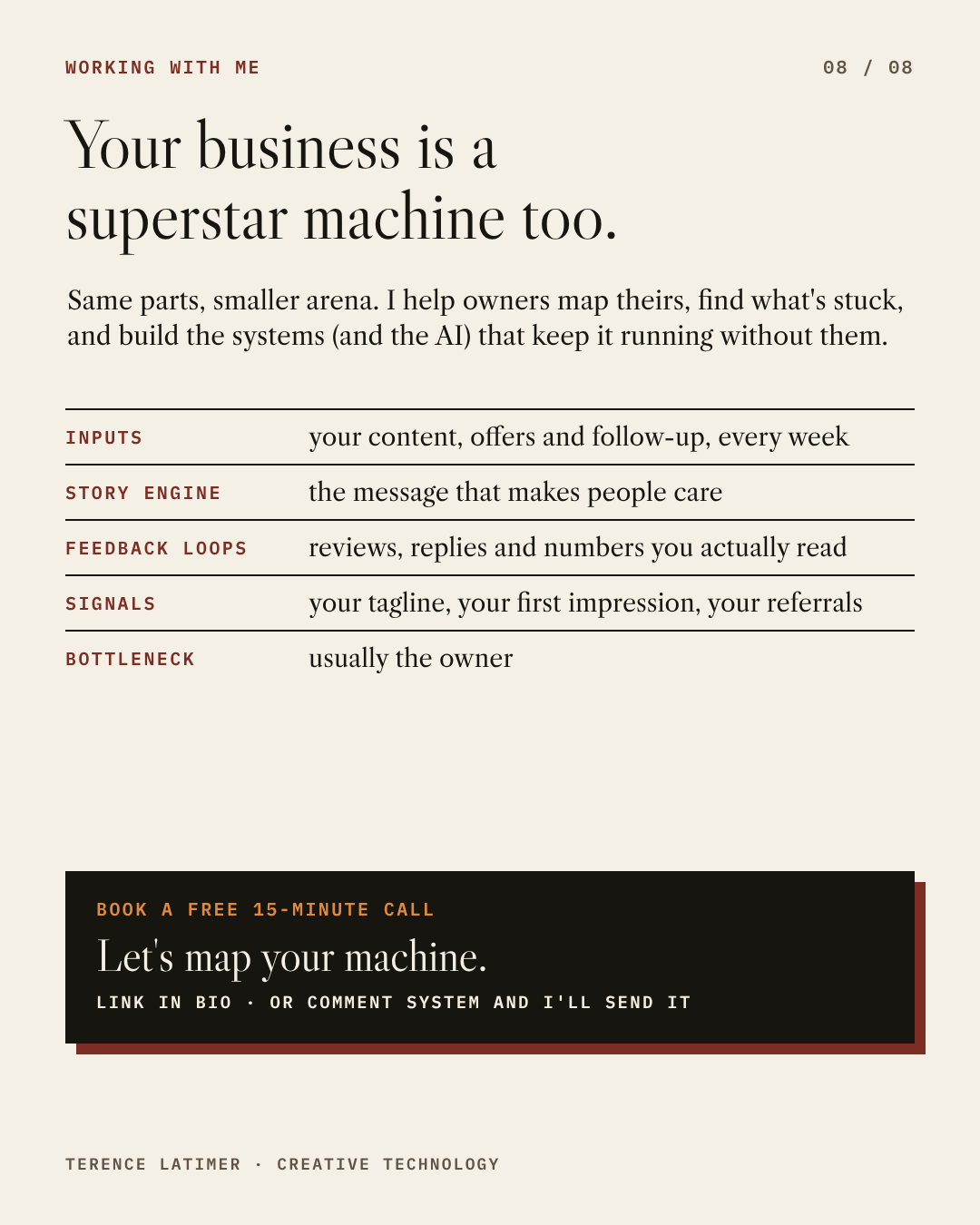
Same parts, smaller arena. Look at your business through the same lens:
- Inputs: your content, your offers and your follow-up, every week.
- Story engine: the message that makes people care.
- Information: reviews, replies, your CRM and ERP, and the numbers you actually read.
- Communication: your website, your emails, your tagline, your first impression. (Here are six communication ghosts that hide in most business systems.)
- Technology: the tools that connect all of it, and the AI that can run the repetitive parts.
- The business bottleneck: usually the owner. If every decision runs through you, the machine can only go as fast as you can.
This is the work I do. I help owners map their machine, find what's stuck, and build the systems, and the AI, that keep it running without them doing everything.
Book a free 15-minute call: let's map your machine
Not ready for a call? Get my monthly letter, Write On, or Five for Friday for five short things every week.
And tell me: Rock or Stone Cold? Reply, or find me on Instagram and leave it in the comments.
More on creative technology and systems
- GTA's Real Genius Is Technology: 29 Years, From a Dot to GTA VI
- JAY-Z 30 at SoFi Stadium: A Creative Technology Review
- Analysis of a Language Event: How One Message Travels in Seven Stages
- I Gave My Business a Second Brain. Here's the Map.
- Is Your Business Haunted? 6 Communication Ghosts Hiding in Your Systems
Sources and credits
- CinemaBlend: the story behind Austin 3:16
- WWE: The Rock's 20 most definitive moments
- Survivor Series (1996)
- Wrestlenomics: Monday Night Wars data
- WCW Monday Nitro
- WWE: WrestleMania XV results
- WWE: WrestleMania XIX
- PBS: Raw moves to Netflix
- Comcast: Peacock and the WWE Network
- Complex: the most iconic WWE shirts
Photos (Creative Commons, via Wikimedia Commons): Stone Cold Steve Austin by Mandy Coombes (CC BY-SA 2.0); The Rock at ringside, 2001, by Tom Kralidis (CC BY-SA 3.0); The Rock, 2001, by Jerry Avenaim (CC BY-SA 2.5). Cropped. WWE, Raw and WrestleMania are trademarks of WWE; this post is independent commentary.